






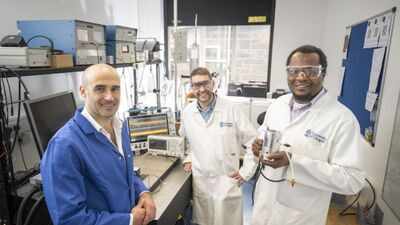
Chemists and engineers have developed a £20 prototype device that uses ultrasound, water and air to produce nitrate, an important nutrient for plant growth. The technology could eventually allow farmers in remote areas to make fertiliser on demand, reducing their reliance on large industrial production facilities. According to a study by University of Glasgow researchers, published in Cell Reports Physical Science titled ‘Towards decentralized nitrogen fixation using pulsed ultrasound’, the process builds on a discovery that was first identified in the 1930s and uses sound waves to convert nitrogen from the air into nitrate.However, the prototype remains at an experimental stage. Although laboratory tests have demonstrated nitrate production, the device currently uses proportionately more energy than the Haber-Bosch process. Researchers also need to determine how effectively the nitrate produced by the device can support plant growth.
How the £20 ultrasound device produces nitrate from air and water
The process begins by bubbling air through deionised water for a few minutes to dissolve nitrogen and oxygen. The researchers then use focused ultrasound waves to create tiny bubbles in the water. These bubbles oscillate rapidly and heat up, with the gases in it reaching temperatures of 5,000°C during repeated pressure-driven implosions.The extreme conditions break apart nitrogen molecules and combine them with oxygen to produce nitrate. To identify the most effective method, the team tested different ultrasound settings and used a high-speed camera to observe the bubbles as they oscillated and imploded.The experiments showed that four-millisecond bursts of ultrasound delivered every 80 milliseconds produced the best results, allowing the team to generate nitrate in laboratory tests.
How much nitrate can the ultrasound device produce in eight minutes
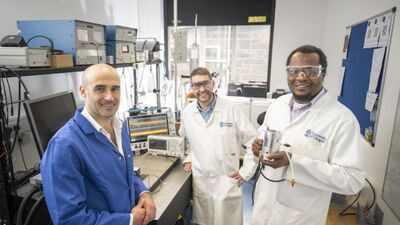
During laboratory experiments, the researchers produced a nitrate concentration of around 40 micromolar in 20 millilitres of water over eight minutes. Although the concentration remained relatively low, the results indicate that the process could be optimised and scaled up to produce more agriculturally useful quantities in future tests.Professor Mark Symes of the University of Glasgow’s School of Chemistry said the team wanted to explore whether fertiliser production could be made possible with minimal capital investment for individual farmers. The existing industrial system relies on factories that can cost hundreds of millions of pounds to produce fertiliser in large quantities. The researchers hope their approach could decentralise production and make nitrate available to farmers through a simpler, more affordable process.
What makes the £20 ultrasound device different from earlier methods
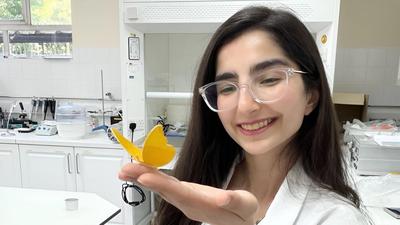
Professor Symes asked Dr Lukman Yusuf, the paper’s lead author, to build a working nitrate production system as cheaply as possible using commercially available components. Dr Yusuf developed a working demonstrator roughly the size of a can of coffee beans for about £20.The underlying process was first identified in the 1930s but was never widely adopted for fixing nitrogen from air. According to Professor Symes, advances in affordable ultrasound technology have created new opportunities in sonochemistry, which uses sound waves to drive chemical reactions.The researchers believe their results mark a substantial improvement in sonochemical nitrate production. However, the current prototype remains an experimental system, and further development is required before the technology can be used in practical agricultural settings.
How are researchers working to improve the £20 fertiliser device
The team acknowledges that its prototype currently consumes proportionately more energy than the Haber-Bosch process. Further research is also required to determine whether the nitrate produced can effectively support plant growth. Dr Paul Prentice of the University of Glasgow’s James Watt School of Engineering said, “Our plan is to spend the next 12 months working intensively to refine the process we’ve pioneered, and reduce the amount of energy it requires.” These developments could help establish whether the technology is suitable for real-world applications. The research received funding from the Engineering and Physical Sciences Research Council and the Royal Society.