






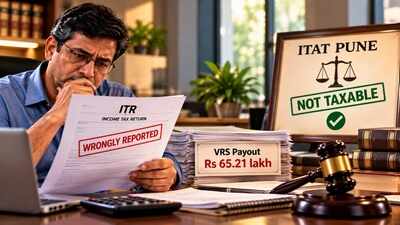
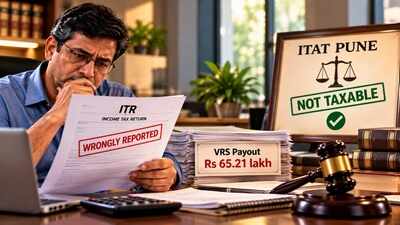
You choose to retire early and get money from your company for the VRS. But you mistakenly report it in a wrong way in your income tax return. What happens then?In one such case a man chose to retire under a voluntary retirement scheme (VRS) following the closure of the manufacturing plant operated by his employer. The manner in which he initially disclosed this amount in his income tax return (ITR), however, led to a prolonged dispute with the Income Tax Department. He eventually won relief at the ITAT level.
What the case is about
The man had been employed in Aurangabad. During FY 2018-19, his employer shut down its Aurangabad plant and introduced a financial scheme for its employees.Also Read | Homebuyer paid Rs 91 lakh upfront for a Rs 1.24 crore property, but circle value rose to Rs 1.46 crore by registration; why ITAT Kolkata gave her tax relief and deleted Rs 11.35 lakh additionThe man opted for voluntary retirement under the scheme and received a total payment of Rs 65,21,105. The amount consisted of ex-gratia/severance pay, early bid and group participation incentives, and payment towards the notice period.He reported the Rs 65.21 lakh as advance salary in his ITR and sought tax relief under Section 89 of the Income Tax Act. Since the department considered this reporting incorrect, it rejected the relief claimed by him.During the subsequent proceedings, the man put forward a different legal argument. He contended that the amount could not be treated as salary in the first place. According to him, it was a capital receipt arising from the loss of his employment and was therefore not taxable.The matter then went before the CIT(A)/NFAC, which took the view that the amount was taxable as “Income from Other Sources” under Section 56(2)(xi). The appellate authority reached this conclusion on the basis that the payment had been received in connection with the termination of employment.The dispute over the correct character of the payment ultimately came before the Pune Income Tax Appellate Tribunal (ITAT).In its ruling dated June 8, 2026, the Pune ITAT accepted the man’s argument and held that the Rs 65.21 lakh constituted a non-taxable capital receipt.
Why did the man win the case in ITAT?
Chartered Accountant Suresh Surana explained to ET that the Pune ITAT, while deciding the case for AY 2019-20, allowed the appeal. The Tribunal held that the amount he received was a capital receipt and therefore was not chargeable to tax.The Pune ITAT consequently overturned the order passed by the CIT(A)/NFAC and directed the Assessing Officer to revise the assessment accordingly.Before the Pune ITAT, the man argued that the payment had arisen from his decision to take voluntary retirement/resignation under a special scheme and was not a payment made as a consequence of termination of his employment by the employer.Also Read | Tax raid finds Rs 1.12 crore cash and Rs 4.34 lakh foreign currency at Delhi man’s home; he fights case twice, sister-in-law’s explanation helps brother-in-law win ITAT battleHe also referred to several earlier decisions of the Pune Tribunal involving other employees of the same company who were similarly placed. In those cases, payments received under the same scheme had been treated as capital receipts and held to be not chargeable to tax.Another argument advanced by the man was that Section 56(2)(xi) would apply only when compensation or another payment was received in connection with termination of employment or a modification in the terms of employment.The scheme, however, specifically stated that cessation of employment under the scheme would be treated as resignation and not as retrenchment or termination by the company.The Pune ITAT accepted this argument. It noted that under the relevant clause of the scheme, employees choosing voluntary retirement were not entitled to compensation or notice pay under the Industrial Disputes Act, 1947.Their cessation from employment was expressly characterised as resignation rather than retrenchment or termination by the company.The Tribunal therefore concluded that Section 56(2)(xi) could not be invoked because the amount had not been received in connection with termination of employment.According to Surana, the Pune ITAT also applied the principle of consistency. The Tribunal noted that, in several cases involving other employees of the same company who had received similar payments under the same scheme, the Income Tax Department had accepted the receipts as capital in nature during reassessment proceedings. Various co-ordinate benches of ITATs had also ruled in favour of similarly placed employees.The Pune ITAT held that the lower authorities had not followed the applicable precedent and had failed to maintain consistency despite the factual circumstances being identical.Thus, the man succeeded because the Tribunal found that the payment arose from voluntary retirement/resignation rather than termination of employment. The amount was treated as a capital receipt arising from the loss of employment/source of income. Section 56(2)(xi) was therefore held to be inapplicable, while earlier co-ordinate bench decisions involving similarly placed Pfizer employees also supported his position.The appeal was accordingly allowed in favour of the assessee.Also Read | He left his BMW locked on the highway after midnight puncture, next morning it was found burnt; insurer rejected claim, but consumer commission orders Rs 70 lakh plus 7% interest