









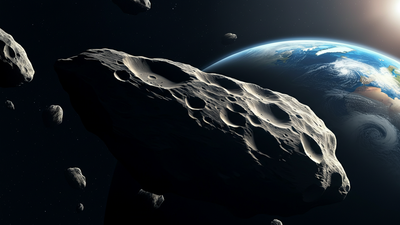
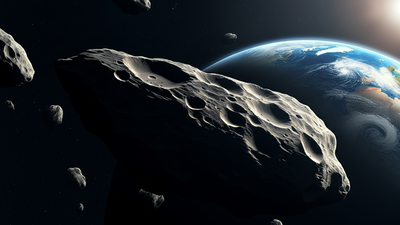
A massive near-Earth asteroid is set to make its closest pass by our planet in roughly four centuries. Numbered 152637 and known as 1997 NC1, the object will fly past Earth on June 27 at a distance of about 2.57 million kilometres, equal to nearly 6.5 times the distance between Earth and the Moon. NASA has classified the asteroid as potentially hazardous, a label given to any large body whose orbit passes close to Earth, though scientists stress there is no risk of impact for at least the next hundred years. First discovered in 1997, the asteroid offers astronomers a rare chance to study an object of this size from such proximity, an opportunity that will not repeat for decades.
What is asteroid 152637 (1997 NC1) and why is it approaching Earth
Asteroid 152637 (1997 NC1) was first spotted in July 1997 by NASA’s Near-Earth Asteroid Tracking program, an automated sky-survey system that operated telescopes at Haleakala Observatory in Hawaii and at Palomar Observatory in California. The asteroid belongs to the Aten group, a category of near-Earth objects whose orbits lie mostly inside Earth’s path around the Sun while still crossing it, occasionally bringing the asteroid close to Venus as well. Its orbit takes it around the Sun roughly every 0.8 years, swinging from just inside Venus’s distance out past Earth’s orbit. Because that path regularly intersects Earth’s own orbit, astronomers have tracked 152637 for nearly three decades, refining its trajectory with each pass to predict exactly how close it will come this year.
How close will the asteroid come to Earth on June 27
At its nearest point, expected at 11:16 UTC on June 27, the asteroid will pass roughly 2.57 million kilometres from Earth, or about 0.0171 astronomical units. That works out to nearly 6.5 times the average distance between Earth and the Moon, comfortably safe but still close enough to count as a rare event for an object of this size. Orbital reconstructions show this is the nearest the asteroid has come to Earth since at least the early 1600s, and current models indicate it will not approach this closely again until 2133. Travelling at roughly 8.87 kilometres per second relative to Earth, the asteroid will cross a vast distance in a matter of hours, giving observatories around the world a narrow but valuable window to gather data.
Why NASA classifies this asteroid as potentially hazardous
The “potentially hazardous” label can sound alarming, but NASA applies it to a broad category of objects rather than singling out an imminent threat. According to NASA’s Jet Propulsion Laboratory, any asteroid larger than about 140 metres whose orbit brings it within 7.5 million kilometres of Earth’s path around the Sun automatically receives this designation. Asteroid 152637 easily meets that threshold, with estimates of its diameter ranging from roughly 700 metres to 1.6 kilometres depending on how reflective its surface is assumed to be. NASA’s Centre for Near-Earth Object Studies continuously monitors objects in this category, and current calculations show no realistic chance of 152637 colliding with Earth for at least the next century.
How NASA’s Goldstone radar will study the asteroid’s size and shape
Telescopes can estimate an asteroid’s size only indirectly, by measuring how much sunlight it reflects, which leaves considerable uncertainty since a large, dark object can appear just as bright as a smaller, lighter-coloured one. To resolve this, NASA plans to point its Goldstone Solar System Radar at the asteroid during its close approach. Marina Brozovic, an astronomer at NASA’s Jet Propulsion Laboratory, has explained that radar observations can pin down not just the asteroid’s exact position but also its shape, rotation rate and surface composition, information that optical telescopes alone cannot provide. Because close, well-observed passes like this one are uncommon, the radar campaign offers scientists an unusually detailed look at a near-Earth object of this scale.
How and when can you see the asteroid from Earth
Skywatchers will get a brief chance to spot 152637 around its closest approach, when its brightness is expected to reach an apparent magnitude of about 10. That is too faint for the naked eye but well within range of a small backyard telescope or a pair of powerful binoculars under dark skies. Observers in the Northern Hemisphere will have the best vantage point for tracking the asteroid as it sweeps past. Comparable close encounters with large near-Earth objects occur roughly once a decade, the most recent involving asteroid 1994 PC1 in January 2022. Until 152637 returns for a similarly close pass in 2133, this month’s flyby remains one of the more accessible opportunities to observe a kilometre-scale asteroid firsthand.