








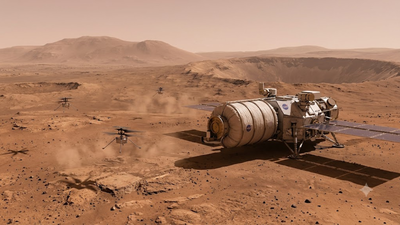
In late 2028, Nasa plans to send something unusual towards Mars, a spacecraft carrying a working nuclear reactor designed to generate electricity for propulsion in deep space. Space Reactor-1 Freedom is intended to test nuclear electric propulsion beyond Earth orbit, where conventional solar power becomes increasingly difficult to use. The spacecraft will not land on Mars. Instead, after its interplanetary journey, it is expected to fly past the planet and release SkyFall, a payload carrying three small helicopters based on the Ingenuity design. Those aircraft are intended to survey the Martian environment, measure weather conditions and use ground-penetrating radar to look for subsurface ice. For Nasa, however, the Mars encounter is only part of the experiment. Freedom is meant to establish practical experience with nuclear-powered spacecraft that could eventually support longer missions to the Moon, Mars and the outer Solar System.
How Nasa’s SR-1 Freedom nuclear reactor will power deep-space propulsion
The basic idea behind SR-1 Freedom is familiar from nuclear power on Earth, but its application is very different in deep space. Nuclear fission releases energy when uranium atoms are split inside a reactor. That heat can then be converted into electricity. As per the Department of Energy, the principle is simply a system that works by “splitting uranium atoms” to generate heat, which is then converted into electricity.For Freedom, that electricity is part of a nuclear-electric propulsion system intended to operate after the spacecraft has left Earth. Nasa lists high-assay low-enriched uranium as the fuel and gives the reactor power-conversion system a 20-kilowatt electrical output, while the spacecraft’s power and propulsion element is designed to generate 48 kilowatts of electrical power. Its propulsion system includes a 12-kilowatt Hall thruster. In other words, the reactor is not simply being carried to Mars as an isolated experiment. It is being integrated into a spacecraft designed to demonstrate how nuclear-generated electricity can support propulsion in deep space.That distinction matters because conventional solar power becomes less attractive as spacecraft travel farther from the Sun. According to Nasa, nuclear electric propulsion could provide efficient mass transport in deep space and support missions beyond Jupiter, where solar arrays are less effective. The agency’s March 2026 announcement described Freedom as “the first nuclear-powered interplanetary spacecraft” and said it is intended to demonstrate advanced nuclear electric propulsion in deep space.
Why Nasa is testing nuclear propulsion on a Mars flyby instead of landing
Freedom is being presented as a first step rather than the finished version of a future nuclear spacecraft. Nasa’s mission plan calls for the spacecraft to launch in late 2028 and reach the Mars vicinity in 2029. The spacecraft will perform a Martian flyby and deploy SkyFall rather than land the reactor itself on Mars. That approach lets Nasa test nuclear propulsion during an interplanetary journey without adding the engineering demands of putting a reactor-bearing spacecraft down on another world.The agency also sees the mission as a way of establishing experience that does not yet exist at this scale. Nasa says Freedom is intended to provide flight heritage for nuclear hardware, establish regulatory and launch precedent and help build the industrial base needed for later fission power and propulsion systems. Its March announcement similarly said the mission would help move nuclear propulsion “from the laboratory and into deep space”.There is a longer-term connection to lunar exploration as well. Nasa says the lessons from SR-1 Freedom will inform Lunar Reactor-1, a planned fission surface power system intended to provide dependable electricity for a future Moon base, including during periods when sunlight is unavailable. The idea is to gain experience with nuclear systems in flight before dealing with the added complications of operating a reactor on the lunar surface.
Nasa’s SkyFall payload will send three Ingenuity-style helicopters to Mars
The reactor is only part of what Freedom will carry towards Mars. Its SkyFall payload is designed to release three helicopters derived from the Ingenuity Mars Helicopter, which became the first aircraft to achieve powered, controlled flight on another planet. Rather than waiting for a conventional rover to move across the ground, the helicopters are intended to provide an aerial view of areas that could be difficult to reach or assess from the surface.Their instruments are designed for more than taking pictures. Nasa says the helicopters will carry ground-penetrating radar and imaging equipment and will measure air temperature, wind speed and wind direction. Radar observations could help locate subsurface ice and estimate its extent and depth, while the combination of aerial imagery and weather measurements could give scientists a different picture of Martian terrain and dust movement.Flying on Mars is not straightforward, despite the planet having much weaker gravity than Earth. Mars has an atmosphere with only about 1 per cent of Earth’s surface air pressure, leaving the helicopter rotors with far fewer air molecules to push against. The SkyFall aircraft therefore have to work within a particularly thin atmosphere. Nasa says the helicopters could potentially remain operational for months or even years, depending on how the mission performs.The mission is also being designed with future human exploration in mind. Nasa is considering relatively flat, low-elevation areas for deployment and landing, partly because the resulting observations could help assess locations for later missions. Finding and characterising possible water ice deposits would be especially useful because subsurface ice could become an important resource for future exploration.
Nasa’s Freedom mission builds on America’s history of nuclear power in space
The United States has used nuclear technology in space before. The SNAP-10A reactor, launched in 1965, became the first U.S. nuclear reactor to operate in space and produced more than 600 watts of electricity before its mission ended after 43 days. Nasa’s Freedom takes the idea further by using nuclear-generated electricity for propulsion in deep space.The US is also developing nuclear power for the Moon, where a planned system could produce up to 40 kilowatts of electricity during the long lunar night. Freedom is designed as a test mission to build experience with nuclear propulsion before such technology is used on larger future missions.If launched in late 2028 as planned, Freedom could help Nasa understand how nuclear propulsion works beyond Earth orbit. Its Mars flyby and SkyFall helicopter deployment would also test new ways of exploring the Martian surface and searching for subsurface ice.