







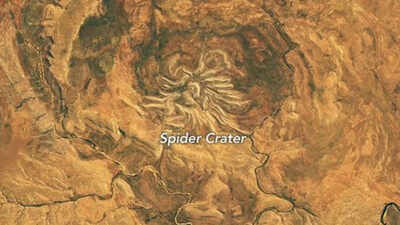
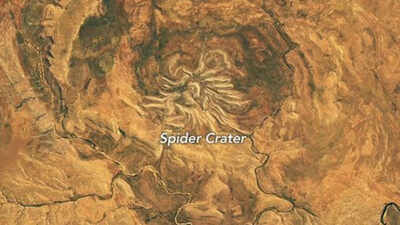
From the ground it may look like just another isolated patch of tough Australian country. From space, however, the landscape takes on an uncanny form: a giant spider etched across the earth. Spider Crater, hidden away in Western Australia’s Kimberley region, isn’t just the work of nature’s more familiar forces. It has a strange shape, created by a meteor strike hundreds of millions of years ago. A recent satellite image has brought the amazing formation into sharp focus, revealing how closely its central pattern resembles the creature that gave it its name.A crater etched by the fury of the cosmosAccording to NASA, the Operational Land Imager on the NASA-USGS Landsat 9 satellite acquired the image on September 20, 2026. Seen from above, the whole impact structure is distinctly oval-shaped, measuring about 13 km by 11 km. At its heart is the feature that gives Spider Crater its disquieting look: a pattern of ridges about four kilometers wide radiating outwards like legs.The formation is believed to be the remnants of a central uplift, a raised section of the crater floor that occurs when the ground bounces back after the massive force of an impact. It started as a violent collision with an alien body, and over a long period, geological processes gradually shaped it.NASA says some of the more durable remnants of the original landscape are the pale sandstone ridges that make up the spiderlike pattern. Over time, the surrounding rock layers weathered and eroded away, leaving these more resistant formations behind, and exposing the unusual structure we see today.
The volcanic enigma of impact craters
Spider Crater did not immediately give away its origins to scientists, according to NASA. There has been 40 years of debate over its strange shape, with competing ideas including the idea that volcanic eruptions created the formation, the NASA report says.As geologists began to study the rocks in the field more closely, that theory began to fade. Key among the clues were shatter cones, unique fan-shaped fractures that form when powerful shock waves move through rock. These structures are closely related to meteorite impacts and were seen all over the central dome of Spider Crater, the NASA report adds.More evidence came from lab studies of shocked quartz and zircon crystals found in the sandstone. According to the report, such minerals can record microscopic evidence of the tremendous pressures created during an impact and give hints about how the collision took place.
A peek into Earth’s distant past
The exact age of Spider Crater is unknown, but geologic evidence in the region surrounding the impact suggests an age between about 900 million and 600 million years ago. This makes the crater a relic of the late Precambrian, long before dinosaurs, flowering plants, or even complex life were familiar features of Earth’s landscape. Over hundreds of millions of years erosion slowly peeled back layers of rock, leaving behind an old impact scar as the striking spider-shaped formation seen from above. NASA’s satellite images today provide a rare look at this geological survivor. Seen from orbit it looks almost playful, but it is in fact the beautifully preserved record of one of the most violent encounters Earth has ever had with space.Image Courtesy: NASA