










On August 15, 2025, Prime Minister Narendra Modi spoke of energy security, announcing the National Deep Water Exploration Mission. “To make the country developed, we are now moving towards ‘Samudra Manthan’ (churning of the ocean). Taking forward our Samudra Manthan, we want to work in a mission mode towards finding oil reserves, gas reserves under the sea and hence India is going to start the National Deep Water Exploration Mission,” PM Modi said from the ramparts of Red Fort.Six months later, India’s energy security saw one of its biggest tests in recent times with the start of the Middle East conflict. It was an unprecedented oil shock and India, which is largely dependent on the world for its oil, LPG, and LNG needs, saw its economy staring at a grim situation.Since then the US-Iran war has subsided and India has also managed to ensure its energy security through a vastly diversified supply chain. But the reality of the dependence remains, and so does the vulnerability.In this backdrop, the Union Cabinet’s decision to approve the Rs 84,084 crore Samudra Manthan – National Offshore Exploration Scheme is being seen as a strategic and possibly game-changing move.
What is Samudra Manthan – National Offshore Exploration Scheme?
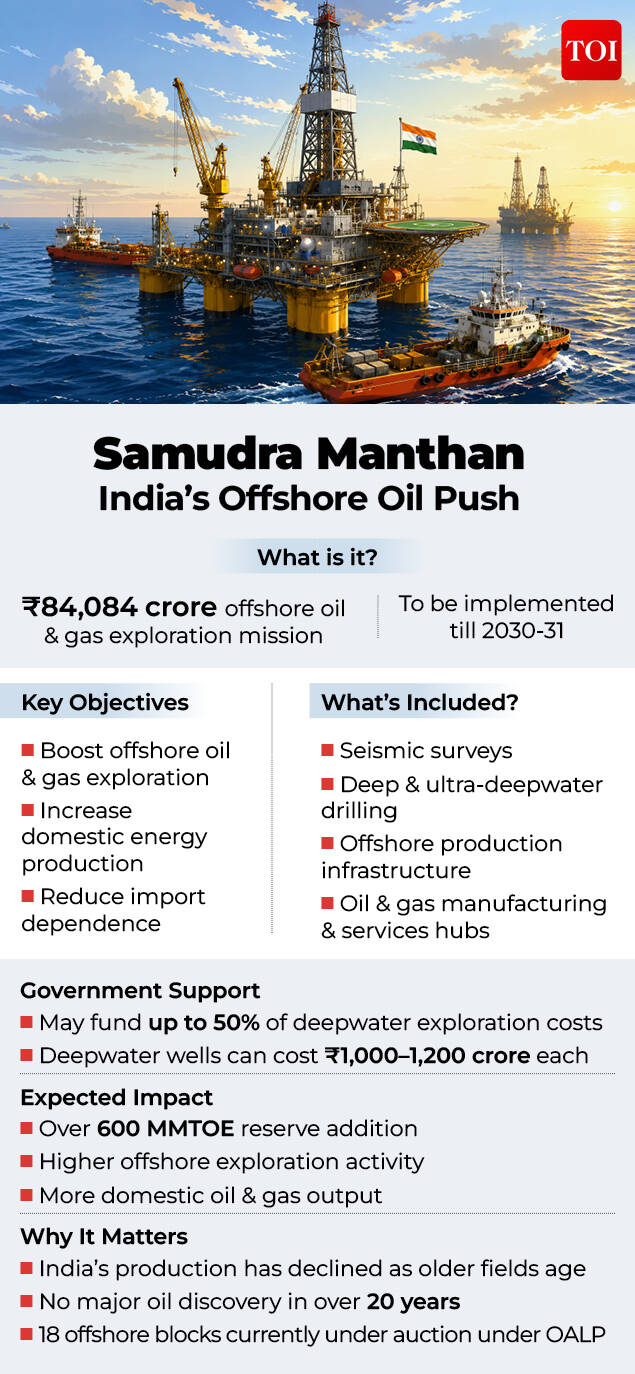
The Samudra Manthan – National Offshore Exploration Scheme aims to unlock India’s offshore oil and gas potential. This will be done through large-scale seismic surveys, deepwater exploration, scientific drilling, shared offshore infrastructure and an integrated manufacturing ecosystem.
What is the Samudra Manthan scheme?
The scheme is expected to add over 600 Million Metric Tons of Oil Equivalent (MMTOE) of reserves and will be implemented through FY 2030-31.Some of the key aspects of the scheme include:
- Large-scale acquisition, processing and interpretation of high-quality seismic data.
- Accelerated deepwater and ultra-deepwater exploratory drilling.
- Scientific drilling in frontier basins.
- Development of common offshore production and evacuation infrastructure.
- Creation of an integrated Oil & Gas Manufacturing and Services Zone.
- Digital programme management, capacity building, technology adoption, stakeholder engagement and international outreach.
- Expected to add more than 600 Million Metric Tons of Oil Equivalent (MMTOE) to India’s reserves.
- Aims to significantly expand offshore exploration and increase domestic oil and gas production.
India’s exposure to oil and gas imports
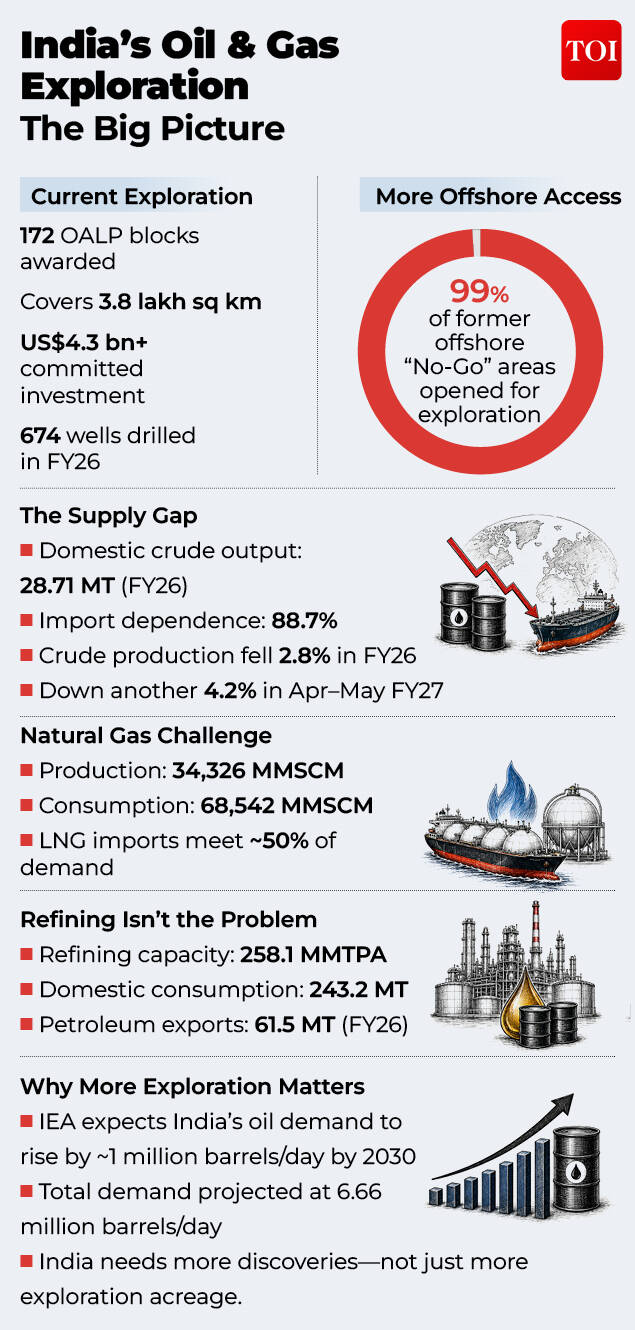
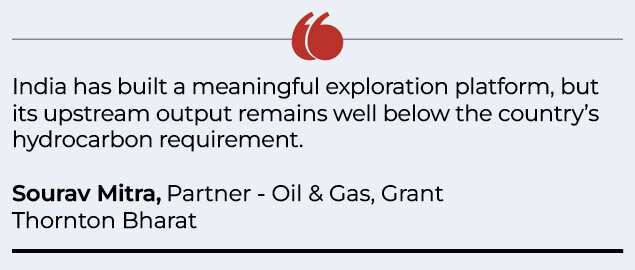
India is a major oil importer with nearly 90% of its crude oil needs being met through imports. The dependence came to stark light amid the US-Iran conflict when closure of Strait of Hormuz left India vulnerable to an oil and gas supply shock. Even as it swiftly diversified its procurement basket, what was obvious was the lack of its own supply.With this backdrop, the Samudra Manthan scheme assumes greater significance. As Sourav Mitra, Partner – Oil & Gas, Grant Thornton Bharat points out: India has built a meaningful exploration platform, but its upstream output remains well below the country’s hydrocarbon requirement.As of July 2026, 172 blocks covering nearly 3.8 lakh square kilometres had been awarded under the Open Acreage Licensing Programme, with committed investment exceeding $4.3 billion; around 674 wells were drilled in FY 2025-26. Nearly 99% of the erstwhile offshore “No-Go” areas have also been opened for exploration. Yet the supply gap remains substantial, he tells TOI.
India’s Oil & Gas Exploration: The Big Picture
As per the Petroleum Planning & Analysis Cell (PPAC), domestic crude oil production stood at 28.71 million tonnes in FY 2025-26, while crude oil import dependence reached 88.7%. “More importantly, domestic production remains on a downward trajectory: crude oil production declined by 2.8% in FY 2025-26, and the decline has continued into FY 2026-27, with production falling by a further 4.2% year-on-year during April–May 2026. Natural gas shows a similar, though less severe, imbalance: PNGRB reports 34,326 MMSCM of domestic production against 68,542 MMSCM of consumption in FY2025-26, with LNG imports accounting for about half of consumption,” Mitra tells TOI.However, this should be distinguished from India’s downstream capability. India has 258.1 million tonnes per annum of refining capacity, compared with 243.2 million tonnes of domestic petroleum-product consumption in FY 2025-26, while exports stood at 61.5 million tonnes in the same year.“In other words, refining capacity is not the principal constraint; domestic feedstock availability is. The demand gap is structural. The IEA expects India to add about one million barrels per day of oil demand by 2030, taking consumption to 6.66 million barrels per day – growth larger than India’s entire present domestic supply. India therefore needs not merely more acreage, but stronger conversion of geological data, drilling and discoveries into commercially producing fields,” Mitra explains.
Importance of upstream output
Significance of ‘Samudra Manthan’
Experts see the Samudra Manthan scheme as a significant strategic initiative for India’s upstream sector. They believe it reflects a shift from simply managing import dependence to actively expanding domestic resource development. It is also being seen as an unambiguous signal that domestic offshore exploration is a key national priority.“The scheme’s focus on large-scale seismic acquisition, deepwater and ultra-deepwater exploration, common offshore infrastructure and technology adoption should improve exploration efficiency and encourage greater investment in India’s offshore basins. If successful, it has the potential to increase domestic oil and gas production, strengthen the domestic oilfield services industry and enhance India’s long-term energy security,” says Sumit Ritolia, Lead analyst, Modelling and Refining at Kpler.India hasn’t made a discovery of the scale of Mumbai High or the Krishna-Godavari basin or the Barmer basin in decades. Rajnish Gupta, Partner, Tax and Economic Policy Group, EY India notes that only a fraction of our sedimentary basin area is meaningfully explored. Vast stretches remain effectively untouched. This, set against import dependence of over 85% for crude oil and 50% for natural gas is the issue that this scheme is designed to address.“The most significant elements are the commitment to large-scale seismic data acquisition and the push into deepwater and ultra-deepwater frontier basins, the areas where exploration risk is the highest. Availability of seismic data and together with exploratory well logs are precisely the geological data that can de-risk exploration activities. Shared infrastructure for production and evacuation can lower the breakeven for blocks that may otherwise be seen as marginal,” he explains.

How the scheme can expand
According to Gupta, what makes this especially significant is the multiplier effect good data can have. Data is not just important for the government but can unlock private capital. “If this exploration push turns up compelling results or if it opens up even new basins or play, that could trigger a wave of private and international investment well beyond the scheme’s own outlay. A single strong discovery, or even strong indicative data, can pull the industry’s attention toward a basin overnight,” he tells TOI.“This is an important policy announcement and along with previous announcements like coal gasification or opening up of the nuclear sector or the recent Urea policy or the recent PLIs for the electronic sector signals that the government is keen to de-risk the economy and build greater resilience in the Indian economy,” he adds.
Challenges and road ahead
The project is a big step, albeit a long-term one with a long gestation period. Hence it should be viewed as a long-term structural initiative rather than a near-term supply solution. According to Sourav Mitra, the principal challenge will lie in converting the exploration activity into commercially viable production.Offshore projects are capital-intensive, technologically complex, exposed to geological uncertainty and typically have long appraisal-to-production timelines. “India drilled around 674 wells in FY 2025-26, while five new discoveries were made and seven discoveries were monetised, underscoring that activity alone does not guarantee commercial outcomes,” he cautions.“The scheme will deliver the greatest value if funding is tightly stage-gated, environmental and safety standards remain rigorous, and success is measured by commercially recoverable discoveries, private investment mobilised and speed from discovery to production not simply by seismic kilometres acquired or wells drilled,” he adds.
Crude dependence unlikely to come down soon
Experts point out that offshore exploration projects typically require several years to progress from seismic surveys and drilling to commercial production. As a result, India’s crude import dependence is unlikely to decline materially over the next 5–10 years. “The immediate challenge remains securing reliable crude imports amid geopolitical disruptions, while this scheme lays the foundation for gradually reducing import dependence over the longer term,” says Kpler’s Ritolia.“If implemented effectively, it could also diversify India’s domestic production base and improve resilience against future supply shocks, but execution, commercial discoveries and timely infrastructure development will ultimately determine its success,” he tells TOI.Experts say that the expected contribution should be viewed as a medium- to long-term reduction in import exposure, rather than an immediate substitute for a defined share of India’s oil demand.“The Cabinet expects Samudra Manthan to catalyse more than 600 MMTOE of reserve accretion. Importantly, MMTOE is an oil-equivalent measure covering both oil and gas, and the announcement provides no oil-gas split or annual production profile. It would therefore be premature to claim that the scheme will meet a specific percentage of India’s oil requirement,” says Grant Thornton Bharat’s Mitra.The Samudra Manthan theme is clearly an important step for India as it looks at securing its energy needs through a mix of domestic production, renewable energy push, and diversification of supply chain.Any commercially viable domestic production resulting from the programme would reduce, at the margin, exposure to imported crude, shipping constraints, foreign-exchange volatility and geopolitical disruption.And that resilience matters in the current market.“The IEA’s July 2026 Oil Market Report said global oil supply recovered to 98.8 million barrels per day in June but remained 9.4 million barrels per day below pre-war levels. However, the scheme runs through FY2030-31, and offshore discoveries require appraisal and development before production. Its strongest contribution will therefore be structural and cumulative; near-term energy security will still depend on diversified import sources, strategic reserves, refinery flexibility and substitution,” Mitra concludes.