









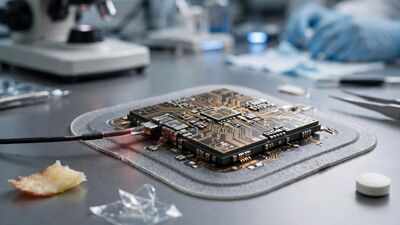
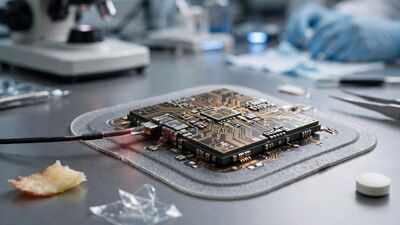
Researchers at the University of Cambridge have developed a compact optical spectrometer that costs around $10 and delivers laboratory-grade precision for applications ranging from healthcare monitoring to food and materials analysis. The device was developed with GlitterinTech, a start-up founded by the same research group.According to the University of Cambridge’s Department of Engineering, it uses a new type of spectrometer, called a convolutional spectrometer, to measure light. The chip operates across a near-infrared range of 1,200 to 1,700 nanometres and supports sub-second sampling and processing. Tests classified plastics, pharmaceuticals, coffee, flour and tea with a 100% success rate.
How the $10 chip analyses light to identify materials
The researchers developed a new class of optical spectrometer that uses the convolution theorem to retrieve spectra. Unlike conventional instruments that disperse light or rely on algorithmic reconstruction, this device physically performs a convolution operation on incoming light. It uses cascaded optical components with periodic spectral responses, including unbalanced Mach–Zehnder interferometers or micro-ring resonators.Proportional tuning shifts the system’s spectral response linearly, allowing the spectrum to be recovered using fast Fourier transforms. Dr Chunhui Yao, a lead author of the study, said, “By using the convolution theorem directly in the optical domain, we avoid many of the limitations that have held miniaturised spectrometers back. This gives us high precision, strong noise tolerance, and very low computational overhead, all in a compact and low-cost system”.
The compact spectrometer maintains stability from -20°C to 80°C
The spectrometer was implemented on a silicon nitride photonic integration platform and packaged with on-board electronics. It operates across an ultra-wide near-infrared range of 1,200 to 1,700 nanometres, with sampling and processing times below one second. Its periodic design allows bandwidth expansion in the spectral domain without changing the hardware. Resolution can also be scaled exponentially by cascading additional components.These features address limitations associated with conventional miniaturised spectrometers, which often sacrifice bandwidth, resolution or accuracy as their size decreases. The researchers also demonstrated that the device remained stable across temperatures ranging from minus 20°C to 80°C, supporting its potential use in wearable, industrial and outdoor settings.
Spectrometer chip classifies food, plastics and pharmaceuticals with high accuracy
The researchers tested the device on several materials and food products. It classified plastics, pharmaceuticals, coffee, flour and tea with a 100% success rate. It also measured concentrations in aqueous and organic solutions with accuracies of around 0.01%, outperforming commercial benchtop spectrometers. These results demonstrated its potential for materials analysis, food testing and industrial quality control.The team designed the system to recover spectral information with minimal computational processing. Conventional high-performance miniaturised spectrometers often require complex calibration procedures and computationally intensive reconstruction algorithms that can be sensitive to noise. By contrast, the convolutional approach supports fast and stable spectrum recovery, making the compact device suitable for applications requiring precise measurements.
Non-invasive glucose monitoring expands the chip’s healthcare applications
The spectrometer also demonstrated non-invasive sensing of human biomarkers under realistic physiological conditions. Tests measured skin moisture, blood alcohol, blood lactate, and blood glucose with high accuracy. The researchers demonstrated glucose tracking over extended periods in a single participant.Project leader Professor Qixiang Cheng said, “These biomedical demonstrations are particularly exciting”.“What makes this work stand out is not just performance in the lab, but technical readiness. Dr Chunhui Yao’s contribution was crucial in translating a mathematical concept into a fully packaged, robust system that operates reliably across temperature extremes and real-world conditions. That combination is what opens the door to practical deployment.”